

The introductory Flask API guide shows how CRUD routes fit together. A production API needs a few more guarantees: it should reject malformed input, return predictable errors, bound expensive queries, and avoid exposing development settings. This article works through those design decisions.
Validate input before it reaches the model #
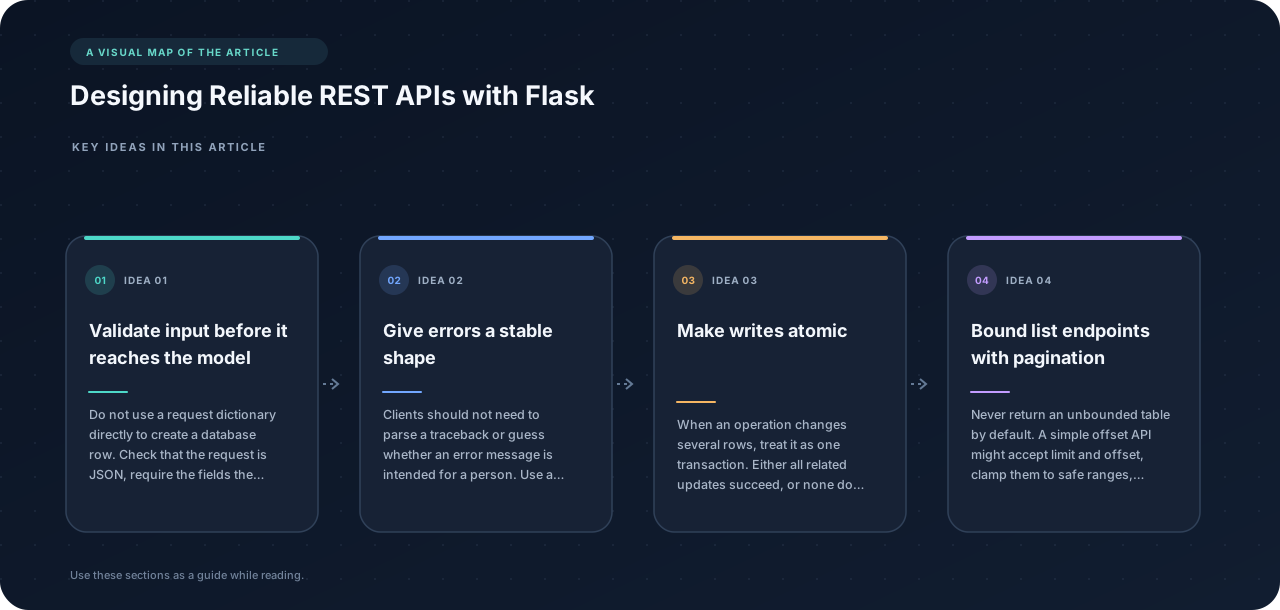
Do not use a request dictionary directly to create a database row. Check that the request is JSON, require the fields the operation needs, and validate each value before writing it:
from flask import request

def parse_book_payload():
    if not request.is_json:
        return None, ({"error": {"code": "unsupported_media_type",
                                  "message": "Send application/json."}}, 415)

    payload = request.get_json(silent=True)
    if not isinstance(payload, dict):
        return None, ({"error": {"code": "invalid_json",
                                  "message": "Expected a JSON object."}}, 400)

    title = payload.get("title")
    author = payload.get("author")
    if not isinstance(title, str) or not title.strip():
        return None, ({"error": {"code": "invalid_title",
                                  "message": "Title must be a non-empty string."}}, 422)
    if not isinstance(author, str) or not author.strip():
        return None, ({"error": {"code": "invalid_author",
                                  "message": "Author must be a non-empty string."}}, 422)

    return {"title": title.strip(), "author": author.strip()}, None
In a larger service, use a schema library to centralize nested validation and produce consistent field errors. Keep validation separate from persistence so both HTTP routes and background jobs can reuse the same rules.
Give errors a stable shape #
Clients should not need to parse a traceback or guess whether an error message is intended for a person. Use a stable envelope with a machine-readable code and a safe message:
{
  "error": {
    "code": "book_not_found",
    "message": "No book exists with that ID."
  }
}
Common status choices include 400 for malformed requests, 401 for missing or invalid authentication, 403 for an authenticated caller without permission, 404 for a missing resource, 409 for a conflicting state, 415 for an unsupported media type, and 422 for a validly encoded request with invalid fields. Choose a consistent convention and document it. Log diagnostic details on the server, but do not send stack traces, database errors, or secrets to clients.
Make writes atomic #
When an operation changes several rows, treat it as one transaction. Either all related updates succeed, or none do. With SQLAlchemy, keep session handling in one place and roll back when a commit fails; return a conflict or server error that matches the failure rather than pretending the write succeeded. Database constraints remain important even when the API validates input, since other writers may bypass the HTTP route.
For updates, decide whether the endpoint follows PUT (replace the represented resource) or PATCH (apply a partial change), and document how omitted fields differ from explicit null. Avoid silently accepting unknown fields if that could hide client mistakes.
Bound list endpoints with pagination #
Never return an unbounded table by default. A simple offset API might accept limit and offset, clamp them to safe ranges, apply a deterministic order, and return paging metadata:
{
  "items": [{"id": 18, "title": "Example"}],
  "page": {"limit": 20, "offset": 40, "has_more": true}
}
Offset pagination is easy to understand but can become slow for deep pages and can shift while rows are inserted. For large or frequently changing collections, cursor pagination based on a stable indexed key is usually more predictable. In either case, cap page size and whitelist sort fields instead of interpolating arbitrary client input into SQL.
Handle retries safely #
Clients may retry after a timeout even when the server completed the original request. For operations that create payments, orders, or other costly side effects, support an idempotency key. Store the key with the operation result under a uniqueness constraint; a repeated request with the same key returns the recorded result rather than creating a duplicate. Define key scope and retention so clients know how long retries are safe.
Protect the service boundary #
- Authenticate callers and check authorization for the specific resource on every request.
- Set request body, page size, and time limits appropriate to the service.
- Use parameterized ORM queries; validate identifiers and whitelist dynamic sort fields.
- Configure CORS only for intended browser origins. CORS is not authentication.
- Keep signing keys and database credentials in a secret manager or deployment environment.
- Run behind a production WSGI server, disable debug mode, and configure trusted proxy behavior deliberately.
- Use database migrations instead of relying on
create_all()to evolve a live schema.
Test the contract, not just the happy path #
For each endpoint, cover valid input, missing fields, wrong types, unauthenticated access, insufficient permissions, unknown IDs, duplicate requests, and database failures. Assert both the status code and error envelope. Include pagination boundary cases and verify that one user’s identifier cannot be used to access another user’s resource.
Reliable APIs are defined by their behavior at the edges: malformed requests, retries, missing records, and partial failures. Clear contracts and bounded operations make clients easier to build and services easier to operate.